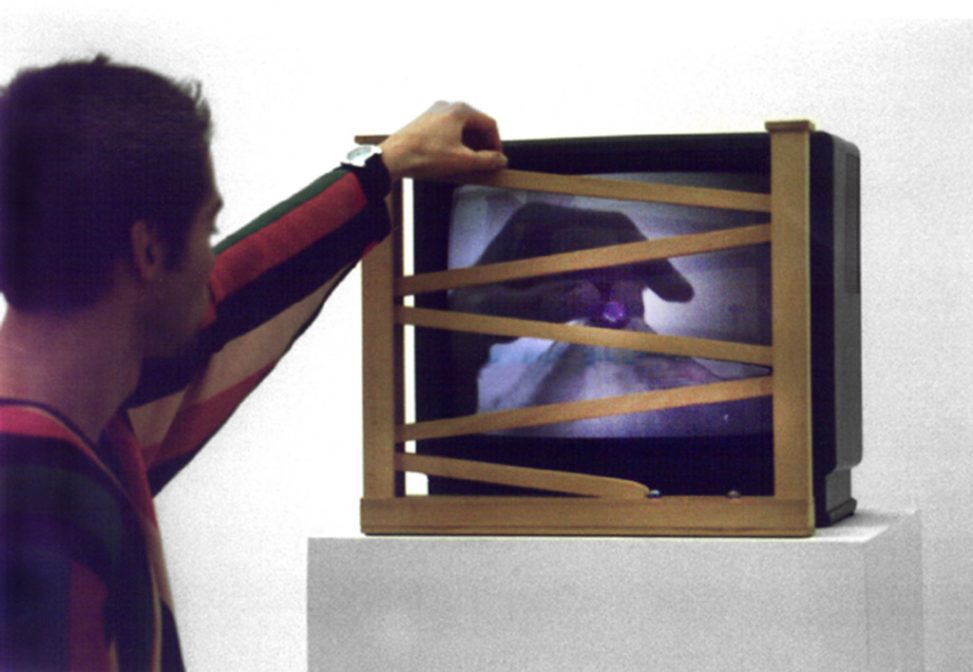
The distance between childhood wonder and the cold logic of the camera eye.
There is something disarmingly familiar about a marble run. The satisfying clatter of a glass sphere negotiating wooden rails, the miniature drama of gravity obeyed — it belongs to a register of experience we associate with innocence, with hands-on causality, with the pre-digital. You put the marble in. The marble goes down. The world makes sense. But in this 1998 interactive sculpture, that reassuring loop is quietly broken open. A marble run sits on a pedestal. Behind it, a television monitor. Embedded along the run’s architecture are four miniature black-and-white cameras, each connected via electric switches to an integrated circuit sunk into the floor. As the marble travels its predetermined path, it triggers contact points that switch the active camera feed — and the monitor shifts accordingly, broadcasting the marble’s journey from within, in real time, from angles the naked eye could never occupy.
The participant still puts the marble in by hand. That part hasn’t changed. But what unfolds afterward belongs to a different ontological register entirely.
What the sculpture stages is less a spectacle than a quiet epistemological crisis. The marble exists simultaneously as object and as image — rolling through physical space while its double flickers on screen, shot in the cool, affectless grey of surveillance footage. The artist describes it precisely: “In the right and left axles and, respectively, back- and forward seems to be a crossing of the marble and its image.” That crossing is the work’s conceptual heart. It is not simply that the marble is filmed. It is that the filmed marble and the physical marble begin to contest each other’s primacy. This was 1998. The language we now reach for — the feed, the stream, the live broadcast of the self — had not yet colonized everyday experience. And yet the sculpture anticipates exactly the perceptual condition that networked cameras and social media would later mass-produce: the strange doubling in which we simultaneously act and watch ourselves act, in which the image of the event begins to feel more real, more legible, than the event itself. The choice of a children’s toy as the vehicle for this critique is not incidental. Marble runs are systems of predetermined paths dressed up as play. The marble appears to travel freely; in fact, it is completely governed by the structure it moves through. The cameras, triggered by electrical contacts at fixed intervals, extend this logic into the visual domain — the viewer’s perception of the marble’s journey is equally structured, equally channeled, by a circuit they did not design and cannot see.
—
Interactive sculpture, 1998
Monitor, marble path, 4 miniature cameras (b/w), electric switches, integrated circuit.